Where Van Gogh Rests


The final stop on my Lust for Life journey
My little Lust for Life journey had brought me to Auvers-sur-Oise.
It seemed rather fitting that my journey following in Vincent van Gogh's footsteps should end in the very place where his own life ended.
I'd been looking forward to visiting for years, but I don't think I was quite prepared for how it would feel to finally be there.
It was a cold, rainy October afternoon, and here I was, walking through the village where Vincent spent the last seventy days of his life.
I could hardly believe it.
Walking Through His Paintings

Auvers is a lovely French village, with old stone houses, narrow streets and gardens tucked behind walls.
What I found so fascinating was 136 years later how much of it was still recognisable from Vincent's paintings.
I visited the Church of our Lady of the Assumption, which he painted as 'The Church at Auvers', I walked through the village where he lived from 20th May to 29th July 1890 recognising many of the scenes he painted creating around 70 paintings and found the extraordinary tangle of tree roots that he painted towards the end of his life which is believed to be his last ever painting created on 27th July the day he shot himself.
I kept imagining him walking along those same roads with his painting equipment, looking for something that caught his eye.
As an artist, that's something I can relate to, you can be walking along quite happily when suddenly a particular colour, shape or patch of light stops you in your tracks
and then, of course, you have to paint it!
Vincent must have found so much to paint here. In just seventy days, he produced an astonishing amount of work.
It's quite incredible when you think about it.
Room No. 5

One of the places I most wanted to visit was the Auberge Ravoux, the inn where Vincent lived and eventually died. We climbed the narrow, rather creaky staircase to the attic, where there were just two little rooms. Vincent lived in Room No. 5, I wasn't quite prepared for how small it was.
The room was bare, with a little light coming through the roof window. It felt terribly sad standing there, knowing this was where he had spent his final days.
I found myself thinking about the contrast between that tiny, rather gloomy room and the wonderful paintings he was creating outside. All those glorious yellows, blues and greens, the movement in his skies and fields, and those unmistakable brushstrokes and then he would return to his tiny room at the Inn.
The artist living in the room next door was the one who alerted Vincent's brother Theo when Vincent was dying. I found that little detail particularly moving. Two artists living side by side in these tiny attic rooms, neither knowing how famous one of them would eventually become.
I stood quietly for a while, trying to imagine what his days must have been like.
It was a very strange feeling to be standing in a room I had read about so many times.
A Little Yellow Flower
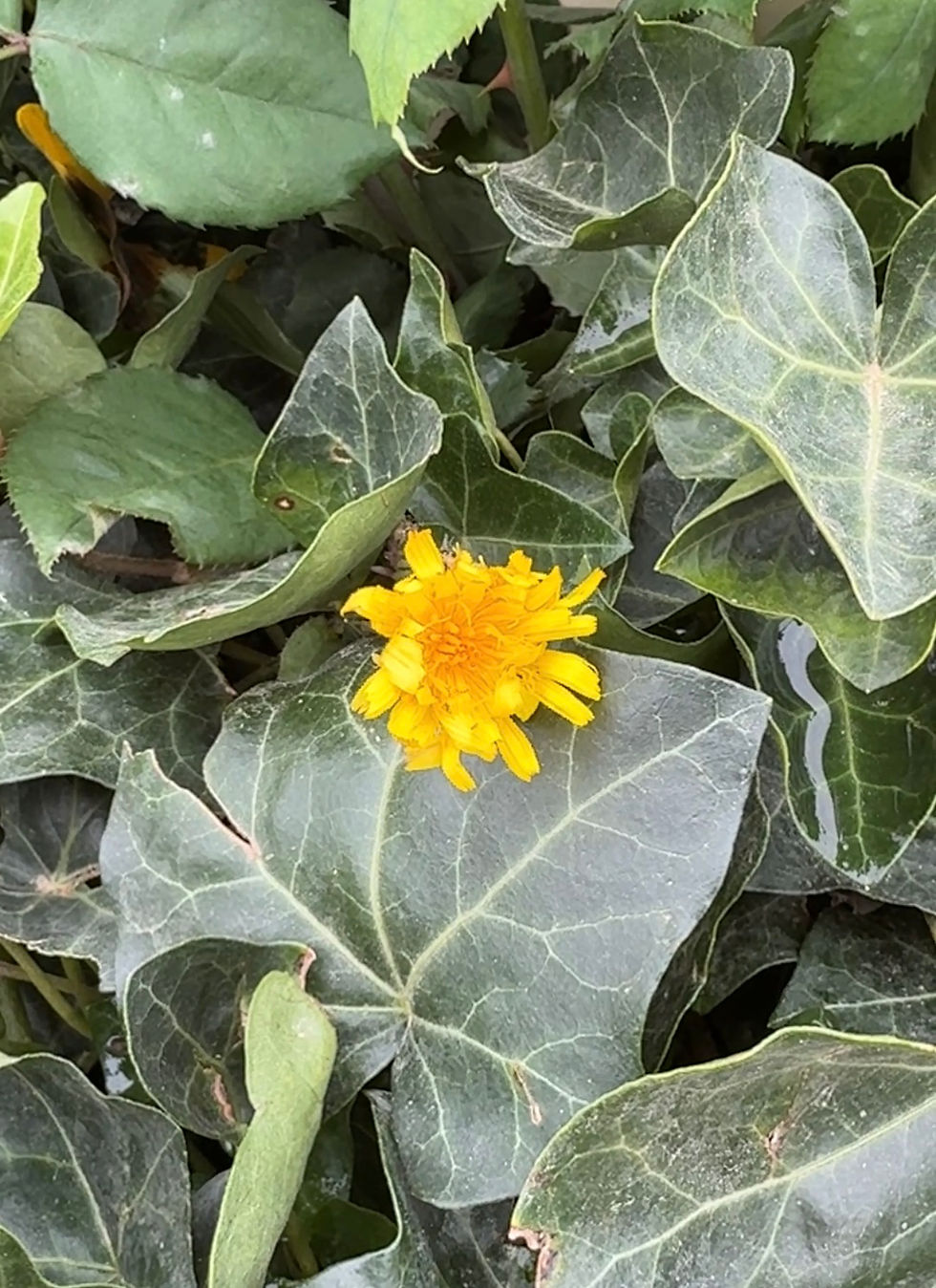
We also made our way to the cemetery where Vincent and his brother Theo are buried.
It was still raining, and everything was rather grey. On the way, I spotted a little yellow flower and decided to pick it to leave on Vincent's grave.
It seemed appropriate somehow, Yellow always makes me think of him.
The cemetery itself is quite simple, and the two brothers are buried beside one another, their graves covered in ivy. I knew exactly what to expect because I'd seen photographs over the years, but actually standing there the feeling was something else entirely.
I placed my little flower on his grave. I don't think I can properly describe how it felt.
Here was an artist whose work I've admired for most of my life, and I was standing beside his grave in this quiet little French cemetery.
I felt sad, of course, but also rather overwhelmed that I was finally here to retrace his footsteps.
A Personal Connection

Van Gogh has another connection to my family.
My father is also an artist, and a few years ago he suffered a stroke that affected his right side. Painting was incredibly difficult for him.
During his recovery, he began copying Van Gogh paintings using pastels. It gave him something to work towards and helped him gradually find his way back to making art.
He still paints today. I found his ability to focus on recovery using art very inspiring.
Vincent could never have imagined that more than a hundred years after his death, his paintings would be helping someone like my dad. I think he would have been rather pleased.
The End of My Journey

By the time we left Auvers, I felt I'd learnt something about Vincent that I hadn't quite appreciated from books and paintings alone.
Seeing the places where he lived and worked made him feel much more real to me.
I thought about how much he achieved in such a short life, particularly during those final seventy days and how sad it is that he never lived to see how much his paintings would mean to people.
My Lust for Life journey had come to an end.
I had walked through the village where Vincent painted, climbed the narrow stairs to his little attic room and finally stood beside his grave.
It was a strange feeling, knowing that I'd reached the end of my journey in the very place where his ended. I keep thinking about that little yellow flower resting on his grave, such a simple gesture, but one I'm so glad I made.
I think that was the moment it really sank in.
I'd finally made it to Auvers, Van Gogh's final resting place.
Natalie x


Comments